If you’d like a shorter/summarized version of our posts, read only the “Highlights” section below and stop before “The Captain’s Log“, which is much more detailed, more like a logbook / diary and contains information for our reference as well.
We write the text for our website in English. The multiple language selection feature is an auto-translation by Google. This translation is not perfect; it sometimes uses peculiar words and even expresses things in a very different way than what we actually meant. So, if you’re reading in a language other than English, and you read something strange, switch back to the English version to read what we actually meant to write!
Highlights – the overview
We are invited to our friends on Bird Song, for late afternoon gathering. We dinghy over and enjoy their company and the sun setting behind Dione IV.


It’s about time…. We had a clock / weather station in the salon but it was over 10 years old and the LCD display was getting dimmer and dimmer over the last year. End of lifetime, obviously. So, when Wim repainted the salon recently, he removed this unit. Then, we noticed we missed it. So, we bought another clock on Amazon. But we were struggling where to put it. Wim wanted to be able to see it at night from our nest without putting on his glasses, so it needed to be close. We experimented with several locations but none was really satisfactory.
This morning, we got an idea: why not build it into one of the brackets in front of the bookshelf? So, Wim got to work with some pieces of plywood. This is the result!


We really like it! Sher says it makes her ridiculously happy… it is so cool, so stylish, and so perfectly placed! We can see it from anywhere in the salon and from the nest 😀

The only thing is, it’s way too bright at night. So, Wim installs a light sensitive relay that switches between 2 little adjustable DC-DC converters. The daylight one is set at 5v (for the USB-C power supply of the clock) and the nighttime one is is turned down to a very dim level of the display, about 1.5v. Because the little clock has a backup battery cell, it keeps the time running while the USB-C power just supplies the LED’s of the display.
Not completely finished yet, it needs painting and some cable ducts but we’re delighted with it!

This evening we have something to celebrate (besides the clock): today, it is exactly 2 years ago that we made our first contact on LoveSail! Yay… happy LoveSail Anniversary!😍😍
Cheers to that with a delicious 20-year old Dos Corvos port wine!

Provisioning is a dinghy ride then a Bolt ride. There’s a big Lidl in town, about a 40 minutes walk from here.
We leave the dinghy tied up on the beach and take a Bolt to the Lidl. It’s only 4 euro’s.
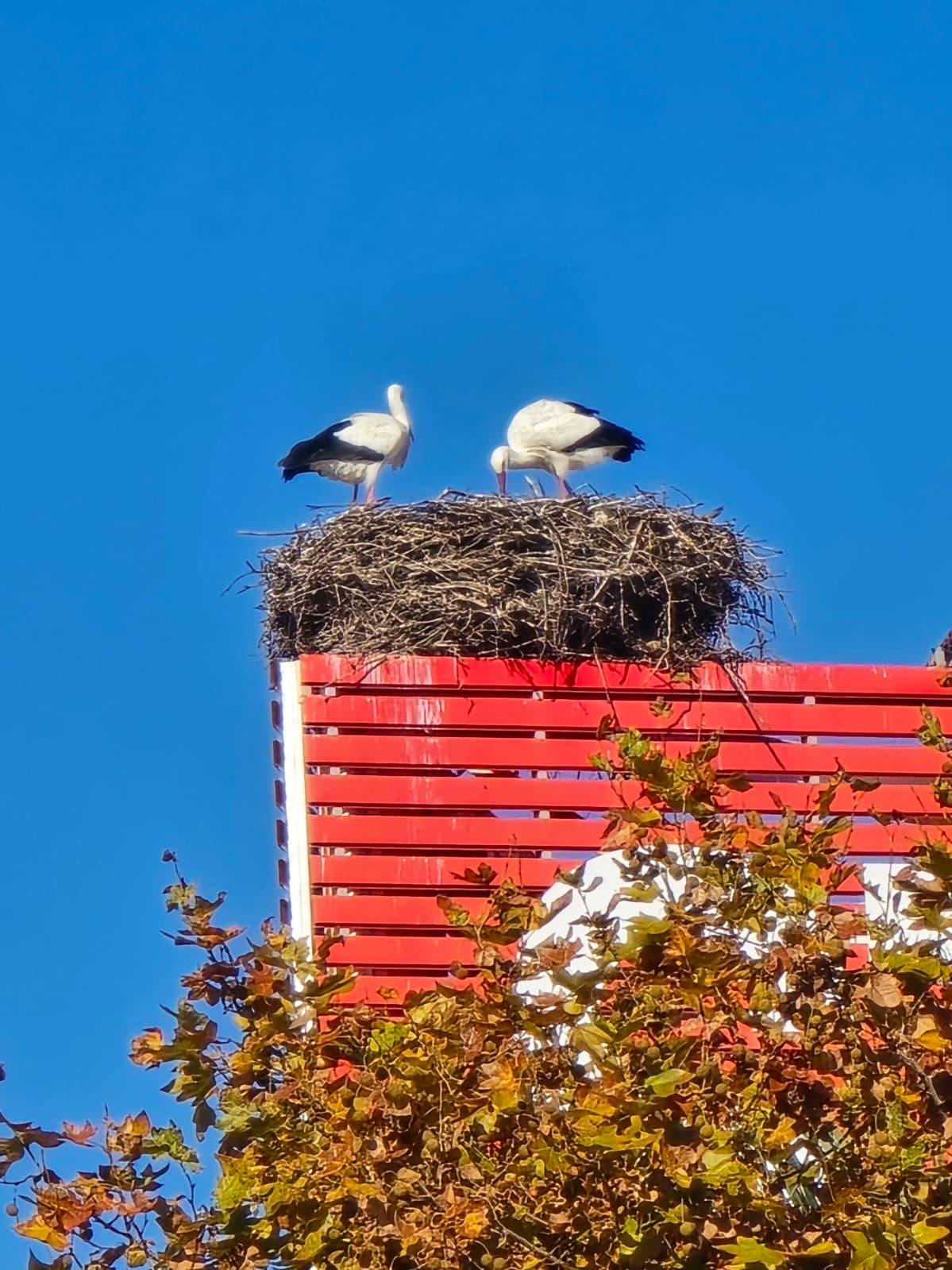
Sher is looking forward to this… not so much for the grocery shopping as for a view of the “locals”. When we get into town, we see stork nests everywhere! So funny!



Because it’s getting cooler now, and with the low temperatures at night (about 7ºC), we are getting some condensation on the hatches. Last year, when we were in Gijon, we bought acrylic sheets to make double glazing. The air between the outer hatch and the inner acrylic sheet keeps the temperature warmer so that condensation doesn’t form. That worked perfectly. We actually hadn’t expected it to be reinstalled in the Algarve region, being so much further south, but because of the very cool northern winds we “winterize” the hatches…


The days are getting shorter and the sun is at a lower angle. And not every day is fully sunny. So, we have just enough yield to cover our energy consumption. But on a sunny and windy day we catch up with 700 watts!
The wind generator helps quite some too, but it is getting rusty and old and we are thinking of replacing it rather than overhauling it. Some research is required first.

We have reserved a month in the marina Portimão. Today, we move from the anchorage to the marina. A bit of pity because the anchorage was so lovely! But, Wim will travel to the Netherlands and it will be more convenient for Sher to be in the marina. And, we’ve decided to stay there for Christmas and New Year.

There’s a boat decoration contest here. Of course, we participate! Below is from Cudillero last year…


We spend the day installing our Christmas lights.
Looking good!


It’s hard to keep everything dry on the boat, with the humidity and salt air. We discovered some mold on clothes in the back corner of the closet. After laundry, it was fine but we’ll have to improve the air circulation…
…and this closet needs a paint job eventually. We install a little fan in the corner. That will improve the air circulation.


Christmas is just around the corner. Time for a tree. Last year we had a cut branch because we couldn’t find a little tree. Unfortunately, the branch got dry and brown by New Years. Sher was determined to find a live one this year. She took a Bolt taxi to a nursery to find just the right small Christmas tree 😄

200 little lights. What a beauty! 💫 And this little fellow will be planted after the holidays and hopefully live a good happy tree life!

Wim is now starting the watermaker installation project. This is how the water maker is going to be installed.
For all the details and step-by-step progress, click here.
Wim takes a small scooter ride along the beach. To the supermarket. Lovely views!


The marina webcam at sunset.


We go for a scooter ride along a nice bicycle path along the river boulevard. On the large square there’s the Christmas market.
We cross the river bridge and visit the storks. We see a baby stork in the nest on right side!

While Wim is working on the watermaker project, Sher is working on a pretty complicated sewing design… a new pattern for a top.
Oops, she has to redo some… but each new pattern requires a test, or two or three, before getting it right.


Sher continues on.
Wim does quite some research on wind generators. We decide to replace the one we have, a cheap Chinese model that lasted for a decade, and found our new one!

It looks good. Sturdy. Not exactly what they promised (all aluminum and stainless steel) but an aluminum housing and galvanized steel rotor base and swivel base.
Next challenge is to mount it on top of our mizzen mast. We will haul the boat out in the next months and will have the mizzen mast dismounted, so can install it then.
Next project… new anchor. We have been talking about replacing the anchor, which doesn’t hold well in mud. So after research and measuring… here it is!
It’s a monster compared to our old anchor! For details, click here


Ready to hoist the new anchor on the bow!
There is still more to enjoy in Portimao and so we will continue on the next post!
The Captain’s Log [T517,518,… 544] – the complete story
Watermaker Installation Project
Wind Generator
Vulcan Anchor
November 24.
A cloudy, windy day with some little rain showers which wash the layer of salt from the decks 🙂. Because the wind comes from the west, some waves enter the area. We rock quite a bit. A number of boats leave to the marina: lightweights! 😉
Sher spends the day resting. It looks like she’s having a little bit of a flue and she lets her body to fight it off.
Wim spends the day working on this website. We were a month behind…


November 25
After one cloudy day, the weather is gorgeous again. Almost no wind, sunny, about 20ºC in the afternoon. Every late afternoon, a beautiful sunset! The nights are chilly, though: about 8ºC.
In the late afternoon, we’re invited for happy hour on “Bird Song” (they arrived last Monday at the anchorage). We dingy over while the sun sets.
November 27.
We had a clock / weather station in the salon but it was over 10 years old and the LCD display was getting dimmer over the last year. End of lifetime, obviously. So, when Wim repainted the salon recently, he removed this unit. Then, we noticed we missed it, to look at the time. So, we bought another clock on Amazon. But we were struggling where to put it. We experimented with several locations but none was really satisfactory. We want to be able to see it by day but also at night, from within our bed…
This morning, we got an idea: why not build it into one of the brackets in front of the bookshelf? So, Wim got to work with some pieces of plywood. This is the result!
We really like it! We can see it from anywhere in the salon and from the nest 😀
The only thing is, it’s way to bright at night. So, Wim installs a light sensitive relay that switched between 2 little adjustable DC-DC converters. The daylight one is set at 5v (for the USB-C power supply of the clock) and the nighttime one is is turned down to a very dim level of the display, about 1.5v. Because the little clock has a backup battery cell, it keeps the time running while the USB-C power just supplies the LED’s of the display.
Not completely finished yet, it needs painting and some cable ducts but we’re happy with it!
This evening we have something to celebrate: today, it is exactly 2 years ago that we made our first contact on LoveSail! 😍😍
Cheers to that with a delicious 20-year old Dos Corvos port wine!
November 28.
Provisioning. There’s a big Lidl in town, about a 40 minutes walk from here.
We leave the dinghy tied up on the beach and take a Bolt to the Lidl. It’s only 4 euro’s.

A view at our anchorage.

When we get into town, we see stork nests everywhere! So funny!
Do these gorgeous sunsets ever get boring?? No, they are addictive 😀

November 29.
Because of the low temperatures at night (about 7ºC), we got some condensation on the hatches. Last year, when we were in Gijon we bought acrylic sheets to make double glazing. That worked perfectly. We actually hadn’t expected it to be reinstalled at the Algarve but because of the very cool northern winds we “winterize” the hatches…

November 30.
The days are getting shorter and the sun is at a lower angle. And not every is fully sunny. So, we have just enough yield to cover our energy consumption. But on a sunny and windy day we catch up with 700 watts!

The wind generator is doing a great deal…
We start thinking about replacing the wind generator. It’s a cheap Chinese one and it’s 11 years old now. Because it’s mainly made of steel, it’s getting rusty. We’ve repainted it last year when we were on the yard in Harlingen but it has some small rusty spots already now. Besides that, the bearings on the rotor shaft are starting to make noise. So, do another overhaul? Or, buy a new one? These wind generators have improved a lot over the years… We decide to investigate…
December 1.
We have reserved a month in the marina Portimão. Today, we move from the anchorage to the marina. A bit of pity because the anchorage was so lovely! But, Wim will travel to the Netherlands and it will be more convenient for Sher to be in the marina. And, we’ve decided to stay there for Christmas and New Year.

Coincidentally, we get a berth next to our friends Annet & Rainier!


Annet & Rainier have picked up a box of paint that arrived after we had left Oeiras.

6 units of the white epoxy paint that we use for the interior. They are very nicely and safely packed!

Yes, we’ll have some more surfaces of old paint to repaint…
There’s a boat decoration contest here. Of course, we participate!
This was Cudillero last year.
We think, we might have a good chance in the contest!
December 3.

Wim flies to the Netherlands to visit his dentist and see his family.
December 4.
The dentist does a great job in repairing Wim’s broken molar! Yay!

Re-stocking our Indonesian spices 😀. They’re hard to get in Portugal.

It’s a cold but sunny winter’s day in Fryslân.
December 5.

A cold and rainy day. 🥶
Wim visits his parents and has lunch with them.

After that, he visits his sister. She has an owl nest in her garden!

There’s the owl nest.

They have a little camera inside. The owl couple is sleeping 😴
December 6.

Back to Faro.
Christmas atmosphere at Amsterdam Airport.

We fly over Olhão. We will anchor there, next month or so.
After a 1 hour taxi ride from Faro to Portimão, happy to be home again!!
December 7.

The weather is gorgeous. Sunny, 20ºC. Big difference with The Netherlands!
We spend the day installing our Christmas lights.
Looking good!

December 8.
We discovered to moldy clothes in the corner of the closet. After laundry, it was fine but we’ll have to improve the air circulation. And this closet needs a paint job.
We install a little fan in the corner. That will improve the air circulation.

we adjust a small adjustable DC-DC converter so that there’s a good circulation and not too much noise.

December 9.
Sher took a Bolt taxi to a nursery to find a small Christmas tree 😄
200 little lights. What a beauty! 💫

Wim starts with installing the water maker. First, cut a bigger hatch and remove some rust. Then, some primer.

The top part was the original removable floor board. The bottom one is the newly cut out one.
This is how the water maker is going to be installed.
Next challenge is to make a foundation and some kind of a watertight box. We don’t want salt water under the floor when it leaks or when we disconnect it for doing maintenance.

Lovely atmosphere when it gets dark and our outside lights switch on.
December 11.

After a day of cutting plywood on the pontoon and gluing the parts together (we had some nice waterproof plywood from the great wood supplier in Koudum, the Netherlands. It was under the mattress in the aft cabin), and puzzling all pieces in the space under the floor, we have a foundation for the heavy water maker. Combined with a 5cm high ridge that will contain the water when it leaks.

This is how it’s going to fit.
We put the water maker unit on rubber silencers. Like this, vibrations will not be transferred to the hull and hopefully it will operate in silence 🤞🏻

Wim glues the 2 pieces of floorboard together and mills out a space for a lock.
Wim: “I love our new battery-powered Dremel in the router!”

The new hatch fits perfectly.
December 12.

Next thing is installing the filter unit for the water maker. It needs several kinds of filtering for the sea water: first, there is the the trough-hull inlet with 2 bars. That prevents large objects like fish and water plants from being sucked in. Then, there is big strainer which also filters the engine cooling sea water and toilet flush sea water. That filters particles like very small fish, weeds and sand. Then, there is a small strainer with a very fine maze. That filters the smallest weeds. This is the existing sea water supply for our toilet and deck wash system.
From here, we’re going to install the sea water inlet for the water maker. That will have an extra filter: a 10 micron cartridge that filters smaller particles like algae and plankton. Wim made a setup with a shut-off valve for the seawater, the filter housing and a 2-way valve at the output of the filter.

Built in the cabinet in front of the washing machine.

The 2-way valve will be used to switch the input of the water maker between the output of the filter (sea water) or a small hose. When switched to the small hose, the water maker will suck fresh water from a container to flush the membrane when not in use or suck a Sodium Metabisulfite (SMBS)/fresh water solution to pickle the membrane when it’s not used for an long time.
The sea water supply is a bit of a complicated plumbing… It leads from the sea water pump into a narrow little corner, along the rain water filters to the new filter unit.


December 13.
A small scooter ride along the beach. To the supermarket. Lovely views!
The marina webcam at sunset.
December 14.

It’s a lovely sunny and warm day. In the morning, Wim does some painting in the cockpit. Primer on all newly made parts.

In the afternoon, we decide to go for a scooter ride. The weather is very nice: really warm.
But: bummer! Sher’s scooter (Louise) doesn’t switch on. Hm. The internal battery is pretty low. We haven’t used the scooters for a while, perhaps we forgot to charge her… But the external battery isn’t charging her… The DC-DC converter in the external battery case is making noise. Funny. We decide to charge the internal battery first, maybe it’s just too low. When Wim plugs in the charger, the scooter switches on. That’s good. Let her charge for a while.
In the meantime, try to figure out what’s wrong with the battery case. Put it on Wim’s scooter. When Wim connects it, a big spark in the plug! Not good. After that, Thelma doesn’t switch on. Bloody! Wim takes out the multi-meter. Zero volts on the out of the battery case. The DC-DC converter must have broken down and have crashed the scooter’s controller…
Well, Louise is fine now and the external battery is charging her. But Thelma stays dead, even when we connect the charger. Wim thinks: OMG, I hope I haven’t bricked the scooter’s controller 😱. Let’s open her up to see if we can find something… Well, nothing to see or smell near the controller… Wim disconnects and reconnects the internal battery and after that, Thelma switches on normally. Just a reset… 🫡

Wim is working in his shorts with no t-shirt on. It’s really warm!
Assemble Thelma again and after that, we can go for a ride! We decide not to take the external batteries because something seems unreliable.
We ride along a nice bicycle path along the river boulevard. On the large square there’s the Christmas market.
On this lovely sunny Sunday, many people are outside, enjoying the sun while eating, drinking, playing, walking.
We cross the river bridge and visit the storks. We see a baby stork in the nest on right side!
December 15.

Wim has a closer look a the malfunctioning battery case. The DC-DC converter makes a humming noise, gets really hot and has zero volts at the output. It appears that the output is short-circuited! That caused the spark when we connected it yesterday and caused the crash of the scooter controller. Clearly, the power electronics (thyristors) have blown.
This is the second time that happened with these DC-DC’s. The first time was in Moaña, when we tried them with the electric dinghy motor. The Chinese manufacturer replaced it free of charge. But they kept causing trouble so we replaced the DC-DC’s for the dinghy motor by another brand. Wim decided to use ‘m for the scooters because these 50A units didn’t get warm at 5A for the scooters. That went well for a few months.
Wim sends a message on E-bay to the manufacturer and explains the situation. They respond: your input voltage is too high. Hm. The input voltage is about 57v at a fully charged battery and these DC-DC’s are rated for 60v. That’s too close, the Chinese guy responds. We recommend 56v as a maximum.

End of story for these DC-DC converters !!

We decide to put the small DC-DC boards back. They have proved to be reliable although they run at max power (3A at 52,8v).

So, they get a bit hot. But we solved that with an external heat-sink.
Everything was still there so it’s an easy job reconnecting the wires.

While Wim is working on the plumbing of the water maker for the rest of the day, Sher visits the market and buys some lovely fresh fennel. In the afternoon, she works on her sewing projects.
December 16.

Today is a windy day. Although we’re in a little green spot, we get some heavy gusts.
So, a good day to work indoors. Wim continues the installations around the water maker and Sher her sewing project.
On the opposite dock, a jib unfurls and is flapping vigorously in the wind!
Nobody on board.

We hurry to the boat and together with our friends Rainier and Ad and 2 guys from the marina staff we manage to get the sail down!

Back to the water maker. Wim installs a new valve in the water cabinet: it’s a 2-way valve that directs the output of the water maker to a test outlet or to the tanks.

A new tube (red) at the sink. This is the test outlet for the water maker.
After turning on the water maker, the first few liters of water have to be disposed. We test the quality of the water by smelling it, testing it with our water tester and finally taste it. If it is all right we can switch the flow of water to the tanks.

While working under the sink, Wim discovers a kink in the tube of the small water maker! It has been running slow for one and a half year and we thought that was caused by the replacement of the membrane…

Wim cuts out the kink and connects the tube with a small piece of hose. The water runs 10 times faster!

Next is the reject water (brine). That goes into the shower drain. That goes overboard.

All hoses in place and electricity connected.
It has to come out once more because the box/foundation needs another layer of paint.

After painting, the water maker will be ready for testing.But that will have to postponed: we will not do that here in the marina because the water is too dirty.
Sher is working on a pretty complicated design…
Oops, she had to redo some…
December 17.
Sher continues her sewing projects.

The result on display 🤩

While Wim continues painting.

At the late afternoon, we get a message that our new wind monster has arrived!
At the anchorage, late November, we had already decided not to overhaul our current wind generator. It’s a cheap Chinese thing and it has been running for 12 years. So, that’s not bad at all. Let’s consider it end of lifetime.
So, we’ve been researching a lot. We’ve looked at numerous cheap Chinese ones (100-200 euro), at the expensive famous brands like SuperWind and such (2000-3000 euro) and it seemed hard to find medium price models. Another thing is, we’d like to keep our 3-fase power rectifier, the Victron MPPT and current-controlled brake relay system. That system works great and is fully integrated in our MG Energy / Victron board system. So, it makes no sense to buy a wind turbine with an integrated controller. Is has to be a 3-fase AC 12v generator with an external controller. Preferably without the controller because we’re not going to use that.
After seeing hundreds of wind generators on the internet we found “Istabreeze”, manufactured in Istanbul, Turkey. They came up with realistic looking specifications (unlike the Chinese), the sales dept was responsive, the generator can be sold without the controller and an amazing price: € 400 for the 800W model. It has a rotor diameter of 1,9m (our current wind turbine is 1,6m). Wim climbed up the mizzen mast to measure the space and concluded that we can handle the larger rotor.
So, we ordered it. It was dispatched from Sofia, Bulgaria 😅
Well, today it was delivered to the marina office.
It looks good. Sturdy. Not exactly what they promised (all aluminum and stainless steel) but an aluminum housing and galvanized steel rotor base and swivel base. So, we have to take care of some corrosion prevention… But, overall it looks better than our current wind generator! So if this can survive another 12 years (minimum), we’re good!
Next challenge is to mount it in our mizzen mast. We’re planning a week on a yard in the next months, maybe in Faro. Then, we will have the mizzen mast dismounted and we will have to match the base of this wind generator to the existing mount on the mast and connect the wires.
December 19.
A small improvement on the external battery pack for the scooters. We had a flat DC connector that didn’t prevent from inserting it reversed. So, we always had to look at the black and red wires to make sure it wasn’t connected in reverse polarity. Tricky.
Now, we have waterproof automotive type connectors with a safety against reverse connecting.


The last couple of days Wim has been painting the foundation for the water maker.
The epoxy paint has cured now and the anti-vibration mounts assembled.

The box in place under the floor.

And the water maker connected.
Ready for a first test! As we wrote before, that will be postponed until we are in nice clean sea water.
Lately, we have been discussing our anchor. As you have read in the past, we have had some trouble with a dragging anchor a few times last summer. Especially in muddy or soft sea beds like the river estuaries often have. In hard, clean sand it was always good and we survived some pretty strong winds in unfavorable conditions. Well, the Delta anchor is well known for that: good holding in sand, bad in mud.
Another issue is the size of the anchor. Our 25kg Delta anchor was in Dick Koopmans’ design of the boat. Dick calculated a displacement of 15,15 tons. That’s where the 25kg anchor is based on. But, the hull is built heavier, we carry 2 tons of water and diesel with full tanks and we have a huge amount of stuff on board. We estimate the displacement currently at 24 tons. So, the 25kg anchor has become undersized.
In Oeiras, we speak to Gösta, from the boat “Smile”. He has been watching 105 (!!) YouTube video’s from a Canadian guy who does nothing else than testing anchors. Here, the Rocna anchors are always the winners. We already knew the excellent reputation of the New Zealand designed Rocna anchors but since Rocna has a roll bar that won’t fit under our bowsprit, it was never an option. But! Now, Rocna manufactures a version without the roll bar: the Vulcan anchor. Wim watches some (but not 105 😅)videos of that Canadian guy. Well, Vulcan even outperforms Rocna sometimes!
So, we decide to give ourselves an expensive Christmas present 😀 that won’t fit under our little Christmas tree 😂 . A Vulcan anchor of the appropriate size!

In this table we choose a bigger boat than Dione IV with approximately her weight (23 tons). So, we are on the safe side. Meaning, a 33kg anchor.

Wim makes some drawings to see if that will fit on our bow.
It should fit under the bowsprit so, we decide to order the anchor!

We decide to order it in the Netherlands at one of Wim’s suppliers. He has a nice discount there. And even with the higher transportation costs is it still a lot cheaper than buying the anchor in Portugal.
Today it has arrived!

But that’s a true wonder… They have completely messed-up the address! It says “industrieweg”, that was Wim’s former business address in Harlingen We are really surprised that it got here…
But there it is!
It’s a monster compared to our old anchor!

With a halyard we hoist the old anchor off the bow.
Ready to hoist the new anchor on the bow!

We pull it into the anchor roller… Flawless! It fits really well! 🥳

When we tension the chain, there’s 2mm left between the anchor and the bowsprit! It fit amazingly well 🤩


We replaced the swivel by a new one. We had a spare one. The old one was a little bend.

This kind of texts make us sleep a lot better at anchor!

👍🏻👍🏻
Leave a Reply